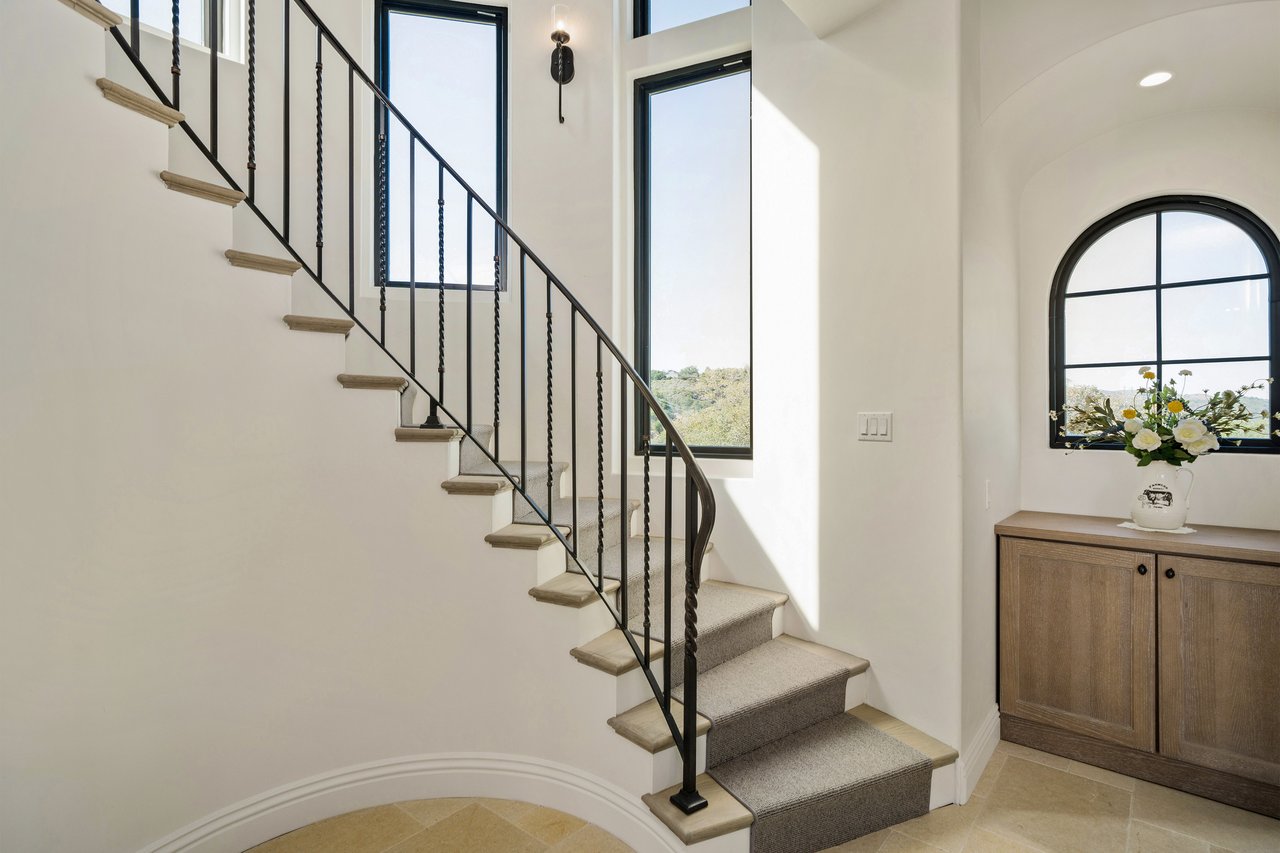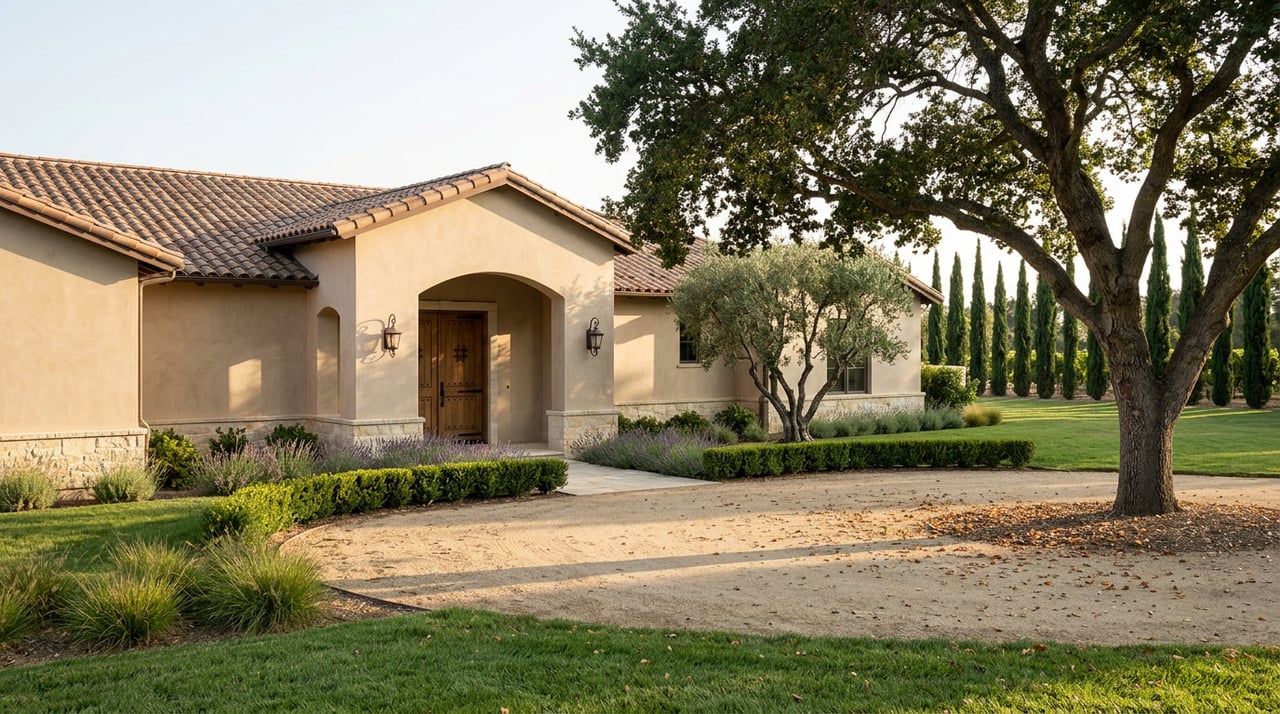
Drive the loop off Jedediah Smith Road and Margarita Road on any given Saturday and you will pass two kinds of houses. One sits behind a hedge trimmed into a hard rectangular line, the kind of landscaping that costs real money to keep looking effortless. Two lots down, a similar-sized custom home on the same two-plus acres has a yard that reads more like a project waiting for a weekend than a finished picture. Both properties are in Santiago Estates. Both are marketed with the same three words: no HOA.
That phrase gets repeated in almost every listing description for this neighborhood, usually paired with "low taxes" as if the two were a package deal. It is accurate. There is no monthly association fee here, no board collecting dues, no CC&R enforcement committee sending letters about paint color. But accurate is not the same as complete. The real story in Santiago Estates is not the absence of a bill. It is the absence of anyone deciding who pays for anything shared.
What "No HOA" Actually Removes
In most of Temecula's newer gated and amenity-rich communities, an HOA does three jobs at once. It collects a predictable monthly fee. It funds a reserve for things that wear out on a schedule, like a clubhouse roof or a shared wall. And it enforces a baseline standard so that one owner's neglect does not become the whole block's problem.
Santiago Estates, built out starting in 1988 according to one aggregator's record, has none of that structure. When you go into escrow on a home there, you will not receive a CC&R packet, a reserve study, or a year of board minutes to review, because there is no board producing them. That is a real convenience during a transaction. It is also a real gap. The paperwork an HOA normally hands you is, in effect, a written answer to the question "what happens if something shared needs fixing?" In Santiago Estates, that question has no written answer. It has whatever your neighbors happen to decide, one lot at a time.
Worth asking your title company about anyway: some older California developments recorded architectural CC&Rs at the time of construction that outlived the association meant to enforce them. Even where no HOA currently collects dues, it is reasonable to check whether any recorded covenants from the original 1988 build-out are still sitting on title, unenforced but not erased.
The Rose Garden Question
Every description of this neighborhood mentions the rose garden at its center, the kind of shared landmark that in a governed community would come with a line item in an annual budget and a landscaping crew on contract. In Santiago Estates, somebody still has to maintain it, along with entry monuments and any perimeter landscaping along the approach roads. Without dues, that work either falls to whichever owners volunteer, gets absorbed informally by a handful of longtime residents, or gradually gets deferred.
None of that shows up in a listing sheet. It shows up when you drive the neighborhood yourself and notice that the shared spaces look exactly as good, or as tired, as the goodwill of whoever last took care of them.
The savings from skipping an HOA are real. They are also the same dollars an association would have pooled to keep shared spaces consistent. In Santiago Estates, that job has no owner.
The Yard Test, and Why It Matters More Than the Tax Bill
This is the part that separates Santiago Estates from a typical no-HOA rural parcel. Because lots here run two to ten acres and homes are typically built at 5,000 square feet or larger, with some newer infill construction closer to 2,500 to 3,500 square feet, the visual range between a well-kept estate and a neglected one is wide, and it is highly visible from the street. There is no architectural review committee to close that gap, and no fine structure to nudge a neighbor toward maintaining the property. What you get is what the current owner decides to put into it, on a lot-by-lot basis, indefinitely.
For a buyer, that has a direct practical consequence. In a governed community, an appraiser and a future buyer largely evaluate your home on its own merits, because the neighborhood's baseline condition is enforced. In Santiago Estates, your home's setting includes whatever the two or three lots around it look like on closing day, and there is no institutional mechanism that will change that for you later. You are not just buying a house and a tax rate. You are buying into a block where consistency is optional.
That is not a reason to avoid the neighborhood. Plenty of buyers specifically want the freedom that comes with no architectural committee looking over their fence line, whether that means room for horses, a working orchard, or a guest house without a design review process. It is a reason to walk the actual block, not just the driveway of the home you are considering, before you write an offer.
A Small Warning About the Facts Themselves
One more wrinkle is worth flagging because it says something about how carefully a buyer needs to verify details in a neighborhood this specific. One national real estate data aggregator dates Santiago Estates to 1988. Another describes the home stock as ranging from the 1960s through the 2000s. Those two claims cannot both be precisely true for the same tract, and the discrepancy is a useful reminder that algorithmically generated neighborhood pages often blend Santiago Estates into broader Temecula-area data rather than describing the community on its own terms.
That matters here more than it would in a large master-planned subdivision, because Santiago Estates is small and idiosyncratic enough that generic data tends to smooth over exactly the details that make it what it is. If a page cannot get the build year right, it is worth being skeptical of anything else it tells you about lot sizes, school assignment, or amenities without checking a second source.
What Buyers and Sellers Should Actually Do With This
For a buyer comparing Santiago Estates to a gated, HOA-run alternative like nearby Bear Creek or a newer amenity community, the honest comparison is not "no fee versus a fee." It is "predictable and pooled versus optional and individual." Ask what a comparable HOA elsewhere in Temecula would typically fund, then estimate what maintaining that yourself, on your own schedule, actually costs. That is the real math, not the headline savings.
For sellers, the takeaway cuts the other way. A well-maintained property in Santiago Estates does more work than the same property would in a governed community, because there is no shared standard lifting the whole street. Buyers touring the neighborhood are quietly grading every lot they pass, and a manicured entry and a healthy front yard are doing marketing work that an HOA would otherwise do for free.
A Few Questions Worth Asking Before You Write an Offer
Does no HOA mean the total monthly cost of ownership is lower? Not automatically. It means the fee is zero, but landscaping, perimeter walls, and any shared-space upkeep become discretionary spending you plan for yourself rather than a bundled line item.
Can I build or plant anything I want since there is no HOA? Likely more freedom than a governed community, but check title for any recorded covenants from the original 1988 development before assuming there are no restrictions on file.
Who is actually responsible for the community rose garden and entry landscaping? No single party, unless local owners have informally organized. It is a fair question to ask a longtime resident or the listing agent directly, since it will not appear in any official document.
Santiago Estates rewards buyers who understand this trade rather than ones who take "no HOA, low taxes" at face value. The land, the privacy, and the acreage are genuinely rare inside Temecula city limits. Just walk the block before you fall for the driveway.
If you are weighing Santiago Estates against another Temecula Valley community, or trying to figure out what a property's shared spaces and neighboring lots really tell you about long-term value, Journey Real Estate can walk the ground with you before you write an offer. Schedule a consultation and we will look at the specific street, not just the neighborhood name.